California Mayors Rally Behind $11.25 Billion Housing Bond as Prop. 1 Heads to Voters
California’s biggest-city mayors are backing an $11.25 billion housing and veterans bond headed for the November ballot. But Republican lawmakers argue California should fix its housing-production system before adding billions to the state’s debt.
Bipartisan group says Proposition 1 could unlock thousands of affordable homes. Republicans warn California should fix its housing bureaucracy before borrowing more money.
A bipartisan coalition of mayors from some of California’s largest cities gathered at the State Capitol on Aug. 19 to make the case for Proposition 1, a sweeping $11.25 billion housing and veterans bond that will go before voters on Nov. 3.
The measure, formally known as the Veterans and Affordable Housing Bond Act of 2026, would direct billions of dollars toward affordable rental housing, homeownership assistance, farmworker housing, student housing and housing infrastructure.
It would also provide $1.25 billion for veterans’ home-loan assistance.
For California cities struggling with soaring housing costs and homelessness, supporters say the measure represents something increasingly scarce: money to turn approved housing projects into actual homes.
“More than 40,000 affordable housing units are shovel-ready.”
Assemblymember Buffy Wicks, one of the measure’s leading supporters, said thousands of projects have already cleared permitting and other regulatory hurdles but remain stalled because developers and local governments lack the necessary financing.
A bipartisan pitch for housing
The Aug. 19 event brought together mayors from Sacramento, Long Beach, San Diego, Fresno, San Francisco and Oakland. Their message was notably bipartisan: California’s housing shortage is too large for cities to solve on their own.
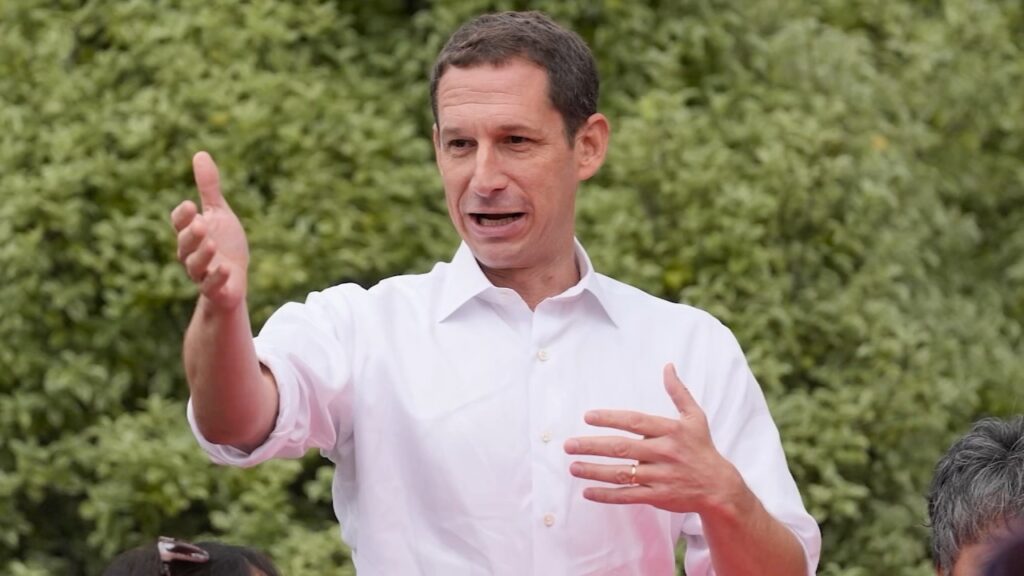
San Francisco Mayor Daniel Lurie was among the mayors backing the measure, putting the city’s housing affordability crisis directly into the statewide debate.
For San Francisco, the issue is particularly relevant. The city faces high construction costs, limited land and a persistent shortage of housing affordable to working- and middle-income residents.
State financing can be critical for projects that otherwise struggle to close their funding gaps.
Sacramento Mayor Kevin McCarty argued that cities need state assistance to address the housing crisis, while Long Beach Mayor Rex Richardson emphasized the need for affordable homes across income levels.
The proposition would provide that assistance through several different programs rather than simply sending cities a single pot of money.
Where the $11.25 billion would go
According to the Legislative Analyst’s Office, Proposition 1 would authorize $11.25 billion in bonds, divided into $10 billion for state housing programs and $1.25 billion for veterans’ home-loan assistance.
The housing component includes:
- $7.2 billion for affordable multifamily rental housing
- $1.1 billion for homeownership programs
- $500 million for housing-related infrastructure
- $450 million for farmworker housing
- $350 million for affordable student housing at UC and CSU
- $200 million for tribal housing
- $200 million for local pilot programs designed to reduce housing costs
- $1.25 billion for the CalVet Home Loan Program for veterans
The state estimates the measure could support assistance for up to 40,000 households seeking homeownership, including approximately 2,100 veterans, while also helping finance tens of thousands of affordable rental homes.
The Governor’s office says the bond could help leverage additional federal, local and private financing, potentially multiplying the impact of state dollars.
Why San Francisco should pay attention
For Bay Area residents, Proposition 1 is about more than subsidized apartments.
The measure targets some of the fundamental pressures driving the region’s housing crisis: the cost of construction, limited affordable inventory and the difficulty lower- and moderate-income households face when trying to buy a home.
That matters in San Francisco, where housing costs have pushed many workers farther from the city or out of the region altogether.
A successful bond could also help local governments preserve existing affordable housing rather than focusing exclusively on new construction. The Legislative Analyst’s Office says Proposition 1 could provide subsidies for up to 40,000 multifamily rental units, in addition to farmworker and student housing.
Supporters also see homeownership as an important part of the proposition. Oakland Mayor Barbara Lee has argued that expanding access to ownership could help address longstanding racial disparities created by redlining and discriminatory lending practices.
For a region where homeownership has become increasingly difficult for younger residents and first-time buyers, that part of Prop. 1 could prove especially significant.
Republicans push back: Don’t borrow your way out of a housing crisis
The bipartisan mayoral support does not mean Proposition 1 has unanimous political backing.
Several Republican legislators voted against SB 417, the legislation that ultimately placed Proposition 1 on the November ballot.
In the Assembly, opposition came from Philip Chen, Carl DeMaio, Stan Ellis, Heather Hadwick, Alexandra Macedo, Kate Sanchez and David Tangipa. In the Senate, Kelly Seyarto and Tony Strickland also voted against the measure.
Their objections go beyond simply opposing affordable housing spending.
During the June 25 Senate debate, Strickland argued that the veterans component was being used to help sell a much larger general-obligation bond.
He also pointed to an existing federal VA loan program and argued that California should pursue private-revenue financing rather than add to the state’s debt.
Seyarto made a different but related argument: California has a housing-production problem as much as it has a funding problem.
He cited a housing project in his district that took years to complete and saw its cost rise dramatically during the process. His argument was that borrowing billions more won’t solve delays caused by environmental reviews, state agencies and other regulatory requirements.
The Republican critique is essentially: build faster before borrowing more.
That argument could resonate with voters who believe California’s housing crisis is partly the result of a system that makes construction extraordinarily expensive and slow.
The real debate: Money or reform?
That tension may define the Proposition 1 campaign.
Supporters point to a straightforward problem: California has housing projects that are ready to move forward but lack funding. They argue that failing to provide the money means losing years of potential housing production.
Opponents counter that California can spend billions and still fail to produce enough homes if permitting, environmental review, local opposition and construction costs continue to slow projects.
Both sides are therefore talking about the same crisis from different directions.
The Legislative Analyst’s Office estimates Proposition 1 would increase state costs by approximately $500 million to $600 million annually for about 25 years to repay the housing portion of the bond.
That price tag will be central to the November debate.
What Bay Area voters should watch
For San Francisco voters, the most important question may not simply be whether California needs more affordable housing. Few would dispute that.
The bigger question is whether $11.25 billion in borrowed money can produce enough housing quickly enough to justify the long-term cost.
Proposition 1 is now officially on the Nov. 3, 2026 ballot, after the Legislature approved SB 417 and Gov. Gavin Newsom signed it into law.
The state’s housing crisis has made another large public investment politically possible. But voters will ultimately have to decide whether this is the right investment, or whether California should first tackle the rules and costs that make housing so difficult to build.
For San Francisco, where the shortage is felt in everything from rents and home prices to the ability of employers to retain workers, the outcome could have consequences well beyond Sacramento.