The Flock Camera Controversy: Safety Tool or Mass Surveillance?
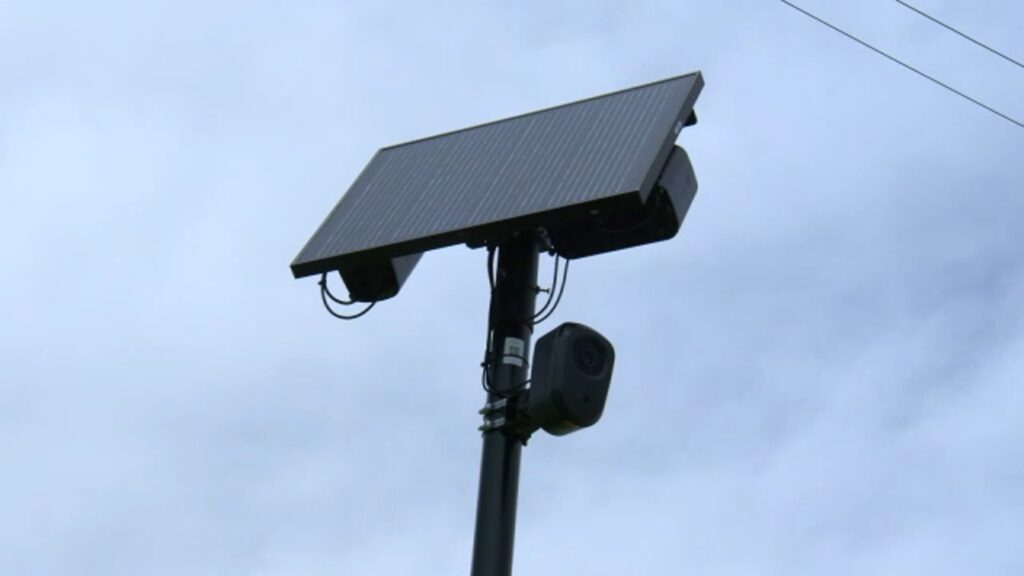
There is a new kind of surveillance camera appearing on American streets, and it looks deceptively ordinary.
Police departments see a powerful crime-fighting tool. Privacy advocates see something much bigger: a nationwide system capable of mapping where Americans drive.
There is a new kind of surveillance camera appearing on American streets, and it looks deceptively ordinary.
Usually mounted on poles or traffic infrastructure, Flock Safety cameras photograph passing vehicles and automatically capture license plates along with other characteristics of the vehicle.
The technology is known as an automated license plate reader, or ALPR.
Police departments say the cameras are enormously useful.
They can help officers locate stolen cars, identify vehicles connected to crimes and find missing people.
But critics are asking a much more uncomfortable question:
What happens when a camera designed to find criminals becomes a system that records where everyone goes?
That question has turned Flock Safety into one of the most controversial technology companies in American policing.
What exactly does a Flock camera do?
At its simplest, an ALPR camera takes a picture of a passing vehicle, reads its license plate and records information such as the vehicle’s make, model, color and distinguishing characteristics.
The important part is what happens next.
Those images can become searchable data.
When cameras are connected across jurisdictions, investigators can potentially look for a vehicle across a much larger geographic area than a single police department could monitor on its own.
Flock now operates more than 120,000 cameras nationwide, according to privacy advocates and recent reporting.
The company’s network has become a significant piece of America’s increasingly interconnected surveillance infrastructure. (American Civil Liberties Union)
That scale is precisely what alarms privacy advocates.
A single photograph of a car is one thing.
A searchable record showing where that car has appeared repeatedly over weeks or months is something very different.
The police case for Flock
Law enforcement’s argument is straightforward: criminals use cars, and cars leave evidence.
A stolen vehicle can be identified by its license plate. A vehicle involved in a robbery can be spotted leaving a neighborhood. A missing person’s car can generate an alert.
Police departments also argue that the technology can make investigations faster without requiring officers to manually watch hours of video.
Flock says its technology has contributed to investigations involving more than one million crimes and helped locate thousands of missing people.
Police organizations maintain that the cameras can be valuable when departments have appropriate rules governing their use. (AP News)
And there is an important distinction between using a camera to find a suspect and simply watching people.
Police say the technology is primarily a tool for the former.
Critics fear it inevitably becomes the latter.
The privacy problem is the network
This is where the controversy gets complicated.
A driver traveling down a public street generally has little expectation that nobody will see their license plate. But critics argue that modern technology changes the equation.
A police officer seeing your car drive past is temporary.
A database capable of recording where your car was at 9 a.m., where it went at noon and where it appeared again that evening creates something much more powerful.
It can potentially reveal patterns of movement.
Over time, that can tell investigators—or anyone who improperly gains access, where someone lives, works, socializes or regularly visits.
The concern is sometimes described as “mosaic surveillance.” Individual observations may seem insignificant, but thousands of observations can produce an extraordinarily detailed picture of someone’s life.
That is why civil-liberties groups argue that the debate should not focus solely on whether a license plate is visible in public. The bigger issue is what happens when millions of those observations are collected, stored and searchable.
And then came the misuse scandals
The controversy became considerably harder to dismiss after investigations uncovered examples of officers using surveillance systems for purposes unrelated to legitimate criminal investigations.
A Washington Post investigation reported cases in which police officers used Flock’s network to investigate or monitor romantic partners and other people for personal reasons.
In one case described by the Post, an officer allegedly used the technology to check whether an ex-girlfriend had visited an abortion clinic.
Those cases are particularly disturbing because they illustrate the fundamental weakness of any surveillance system:
The technology may be neutral. The people operating it are not.
Flock CEO Garrett Langley has acknowledged that misuse by individuals cannot be eliminated entirely, while arguing that systems can be designed to identify and punish abuse.
Flock subsequently announced new safeguards, including requirements that searches be associated with criminal case numbers and expanded monitoring for unusual activity.
The company has also moved toward shorter default data retention and tighter controls on sharing.
Privacy advocates, however, say those changes do not solve the underlying problem.
California has already seen the fight
This is not a distant debate for California.
In Los Angeles, the LAPD temporarily halted its relationship with Flock in July amid concerns about data storage and sharing, including the possibility of information being accessed by other agencies.
The department subsequently began negotiating a new arrangement with additional safeguards.
San Francisco is also part of the larger ALPR conversation.
The city has hundreds of automated license-plate readers, including cameras supplied by Flock, making the technology particularly relevant to Bay Area residents concerned about how increasingly sophisticated surveillance fits into a city already saturated with cameras and digital systems.
The question for cities is no longer simply whether they want cameras.
It is who controls the data, how long it survives, who can search it and what prevents that information from being used for something entirely different from the reason it was collected.
Could your information leave your city?
This is another reason people are paying attention.
Flock’s network is not necessarily confined to the city where a camera sits.
Networked surveillance means investigators can potentially access information collected elsewhere, subject to the agreements and policies governing the system.
That creates a fundamentally different form of policing.
A department doesn’t necessarily need cameras on every street if it can potentially obtain information from cameras installed in neighboring communities.
Privacy advocates argue that this creates a surveillance network that residents may never have voted for and may not even know exists.
And once multiple agencies participate, local restrictions can become harder to enforce.
The political backlash is getting bigger
Flock has become an unusually bipartisan political issue.
Civil-liberties organizations on the left have attacked the technology as an expansion of government surveillance.
On the right, privacy-focused activists and politicians have increasingly embraced similar concerns about government and corporate power.
That unusual coalition has helped push Flock into the political mainstream.
The cameras are now becoming an issue in elections, city council meetings and debates over policing policy.
The Associated Press recently reported that Flock had become a significant issue ahead of the 2026 midterm elections, with candidates from both parties calling for restrictions or stronger oversight. (AP News)
Meanwhile, dozens of municipalities have reconsidered, rejected or ended Flock contracts.
So, are the cameras actually bad?
That’s where the debate becomes less black and white.
It is entirely reasonable to believe that police should have access to tools that help locate stolen vehicles, missing children or dangerous suspects.
It is also reasonable to believe that the government shouldn’t maintain a detailed record of everyone’s movements indefinitely.
Those positions aren’t necessarily contradictory.
The real question is where the line should be drawn.
A sensible framework could include:
- Short limits on data retention.
- Warrants or judicial approval for searches involving historical movement patterns.
- Strict rules preventing immigration enforcement from accessing locally collected data where prohibited.
- Mandatory logging of every search.
- Independent audits.
- Serious penalties for officers who misuse the system.
- Public disclosure of camera locations and contracts.
- Community approval before new surveillance systems are deployed.
- Clear rules governing whether other agencies can access the data.
The technology itself isn’t necessarily the enemy.
Unrestricted access is.
Why people are really freaking out
The fear surrounding Flock isn’t really about a camera sitting on a pole.
It’s about what happens when thousands of cameras, artificial intelligence, searchable databases and interconnected police departments are combined.
That combination changes surveillance from something occasional into something potentially continuous.
For ordinary drivers, the unsettling realization is simple:
You don’t have to be suspected of a crime to be recorded.
You just have to drive past the camera.
And once that information enters a searchable network, the question becomes not whether someone saw you, but how easily someone can reconstruct where you’ve been.
That is why Flock has become such a lightning rod.
Supporters see a modern investigative tool that can help police catch criminals.
Critics see the beginnings of a system in which the government can quietly map the movements of an entire population.
Both sides are talking about safety.
They’re simply defining the word very differently.
The bottom line
Flock cameras aren’t automatically proof of a dystopian surveillance state, and they aren’t merely harmless traffic cameras, either.
They are powerful infrastructure.
The debate Americans are having now is whether the rules governing that infrastructure are powerful enough to protect the people being watched.
That may ultimately be the question that determines whether Flock becomes a permanent part of American policing, or a technological experiment that went too far.